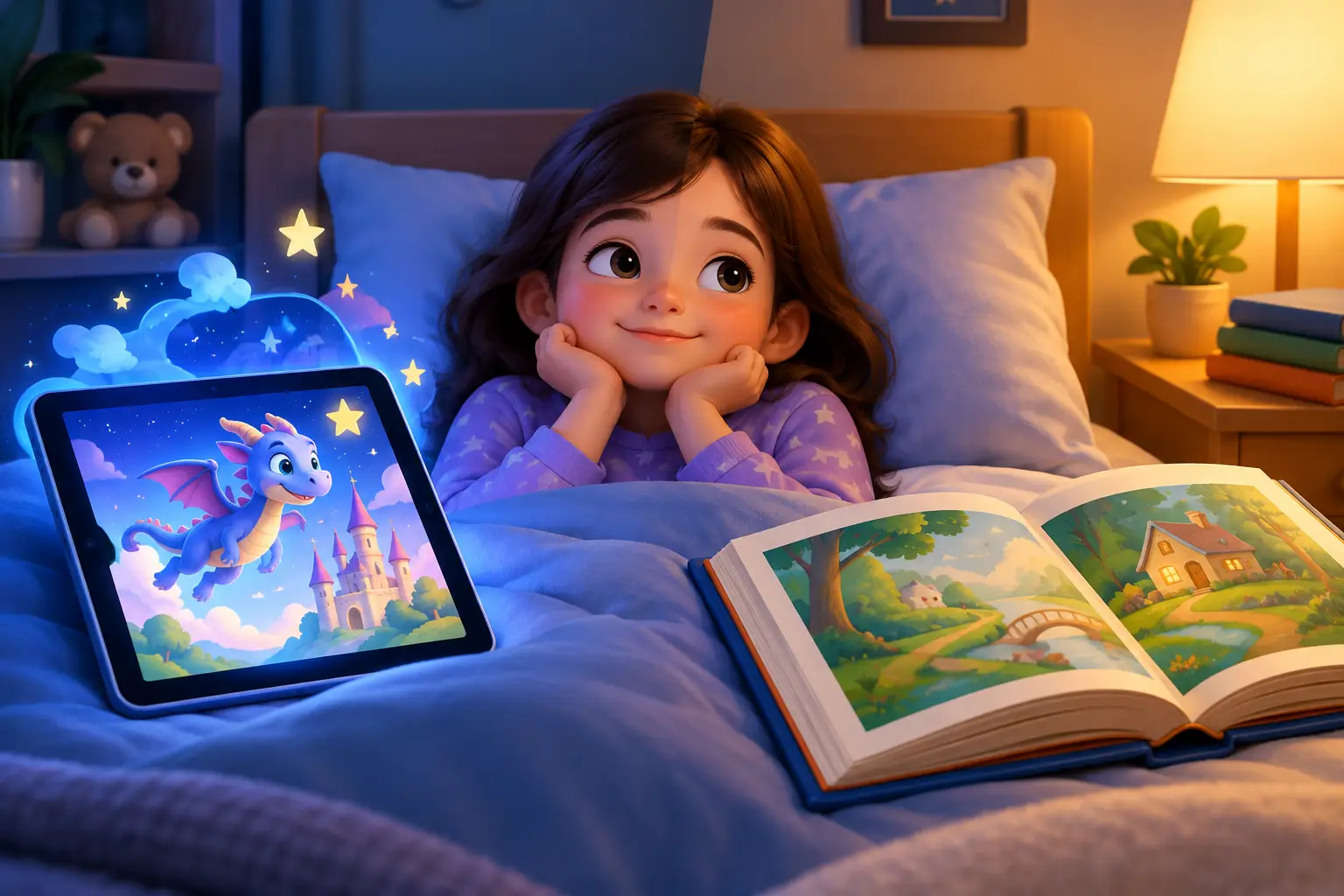
A child who asks for the same story again is not being difficult. They are often returning to a familiar, comforting place: the bit where the friendly fox appears, the funny voice you always use, the moment the hero finds their courage. When weighing story apps versus ebooks, the most helpful question is not which format is better in every home. It is which one supports the kind of bedtime your family wants to create.
For some families, an ebook keeps a much-loved library close at hand. For others, a story app adds a fresh sense of wonder by making a child part of the tale itself. Both can have a place in a gentle evening routine, especially when the grown-up beside the child remains the heart of the experience.
Story apps versus ebooks: what is the real difference?
An ebook is a digital version of a book. It may be read on an e-reader, tablet or phone, and it usually offers a fixed story: the same characters, words and illustrations each time. That consistency can be lovely. Children often build language, confidence and anticipation through repetition, and a familiar digital book can feel as cosy as a well-worn paperback.
A story app can do more than display pages. Depending on the app, it may invite families to choose a child’s name, appearance, interests or companions, then create a story around those details. Instead of simply following a character’s adventure, a child may hear that they are the brave explorer, the kind friend or the clever problem-solver.
That distinction matters at bedtime. Ebooks offer choice from a collection of established stories. Story apps can offer the feeling that tonight’s story was made especially for the child tucked under the covers. Neither approach replaces the warmth of reading together. The format simply changes the path into that shared moment.
Why ebooks still belong in a bedtime routine
Ebooks can be wonderfully simple. If your child has a favourite author, series or traditional tale, a digital library makes it easy to carry those books from one room to another or take them on holiday. There is no need to pack several heavy titles when one device can hold a family’s regular reads.
They can also help maintain predictability. A child who finds comfort in knowing exactly what comes next may enjoy revisiting the same ebook for weeks. You can pause on an illustration, ask what they think a character is feeling, or let them finish a line they know by heart. Those small exchanges build connection and early reading skills without asking the story to do anything flashy.
There are trade-offs, of course. Many ebooks are designed for independent reading or browsing, which can make it tempting to hand over the device rather than settle in together. Some reading platforms also place store pages, recommendations or other distractions close to the book. For young children, the calmest experience is usually a carefully chosen title, opened by an adult, with notifications switched off and a clear end point.
Ebooks may also feel less exciting to a child who has already heard a particular story many times. Familiarity is valuable, but it does not always solve the evening question of, “What shall we read tonight?”
What a personalised story app can add
Children notice when a story makes room for them. Hearing their name in a magical adventure can turn listening into participation. A shy child might enjoy being the hero who helps a lost moon find its way home. A child fascinated by diggers, dinosaurs or deep-sea creatures may be more willing to settle down when the story begins somewhere they already love.
Personalisation is not only about novelty. It can support emotional connection. Stories give children a safe little space to meet big feelings: nervousness about a new nursery class, excitement before a birthday, missing a grandparent or worrying about the dark. When the main character resembles them, the reassurance can feel close and understandable without becoming a lecture.
A service such as Serene Stories is built around this idea: magical, personalised bedtime stories that make your child the hero. Parents can create a child character, build a collection of completed stories and return to favourites whenever they wish. The story remains a starting point for closeness, not a substitute for it.
A well-designed story app can also ease the pressure on tired carers. At the end of a long day, choosing a meaningful story from scratch can feel like one task too many. Having a private library of child-centred tales ready to read may help keep bedtime gentle and consistent.
The screen question deserves an honest answer
It is sensible to think carefully about screens before bed. Light, notifications and fast-moving entertainment can make winding down harder for some children. Yet a bedtime story on a screen is not automatically the same as energetic screen time. Context matters: the brightness, the content, the pace, the adult’s involvement and what happens once the story ends.
If you use an ebook or story app in the evening, treat the device like a book rather than a toy. Choose a quiet setting. Lower the brightness or use a warmer display mode if available. Keep sound gentle, or read aloud in your own voice. Turn off alerts before you start, and avoid hopping between apps once storytime has begun.
It also helps to create a simple ritual around the screen. Perhaps the device stays with the grown-up, the child chooses between two stories, and the final page is followed by a cuddle, a goodnight phrase and lights out. Predictable boundaries make the technology feel like one small part of bedtime rather than the activity that takes over the room.
Every child responds differently. If your little one becomes more alert, upset when the story ends or eager to keep tapping, an ebook or app may work better earlier in the evening. You might save printed books for the final ten minutes, while using personalised stories after bath time. There is no prize for doing bedtime one particular way.
Choosing between story apps and ebooks for your family
Start with your child, rather than the device. A child who treasures familiar characters and repeated phrasing may get the most from ebooks, especially alongside printed favourites. A child who lights up at the chance to star in a story may find personalised tales especially engaging. Many families will enjoy both, choosing according to the evening.
Consider how much control you want over the experience. An ebook from a known publisher may offer a story you already trust and recognise. A story app may offer more flexibility, but it is worth checking how characters are created, where stories are stored and what privacy controls are available. When a service uses information about children, clear settings and a thoughtful children’s privacy approach should be part of the decision, not an afterthought.
Think, too, about the role you want to play. The strongest bedtime reading moments rarely come from the format alone. They come from your voice slowing down, your child leaning close, and the pause you leave for a question about the sleepy dragon or sparkling forest. Whether the words appear in an ebook or a personalised app, reading together gives the story its lasting magic.
Make the story part of the comfort
The best digital bedtime story is one that helps the room grow quieter, not busier. Keep the choice small, the setting calm and the attention shared. Let your child revisit a beloved ebook when they need certainty, and offer a personalised adventure when they need to feel seen.
Tonight, the most meaningful page may be the one where your child recognises their own courage in the hero - then closes their eyes knowing you are right there for the next chapter.