
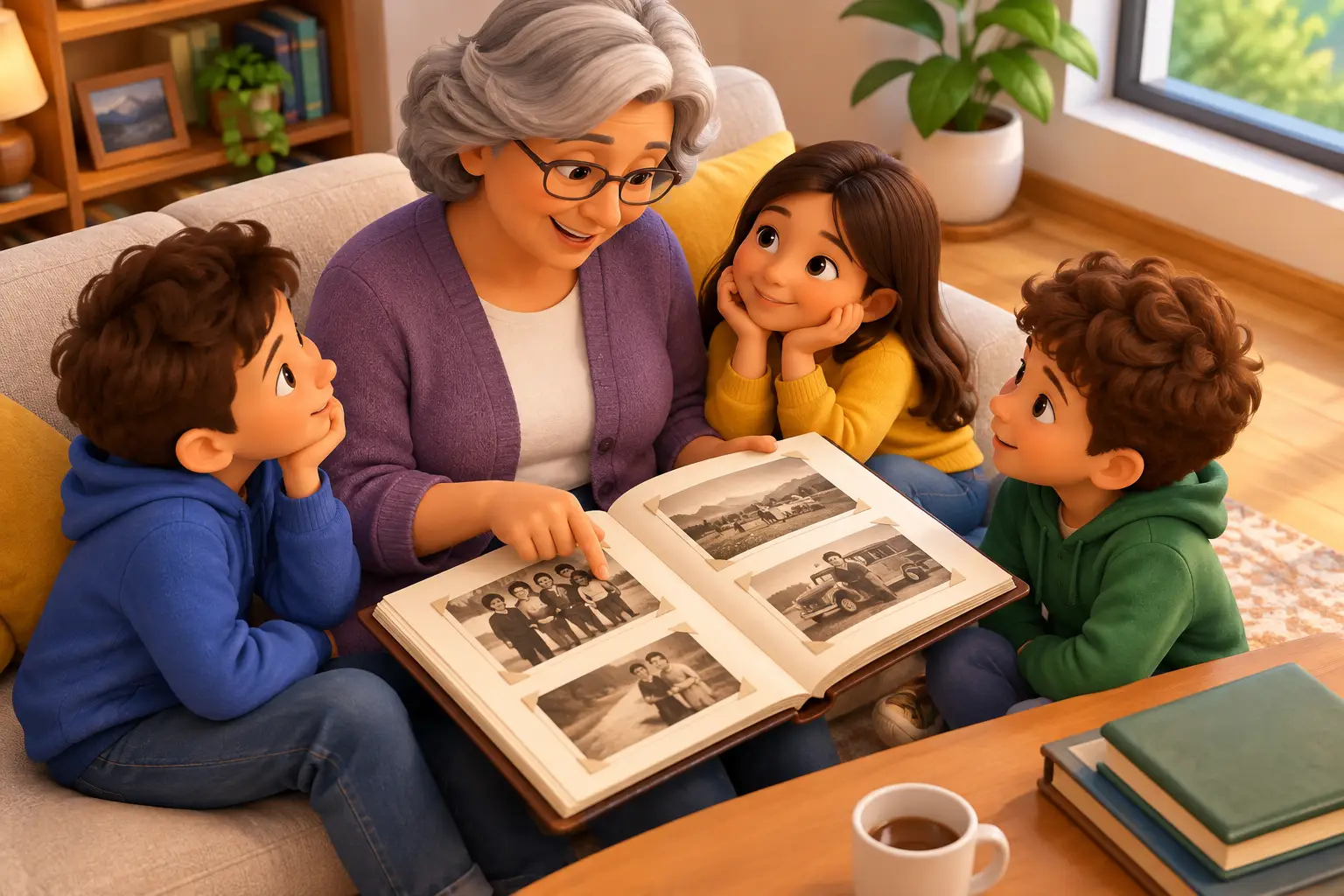
A child who hears, “You have your grandad’s curious questions,” is hearing more than a sweet comparison. They are being given a place in a larger story. Sharing family stories helps young children understand who loves them, where familiar traditions came from, and how they belong - even before they can fully grasp the passing of time.
These moments do not need to be formal history lessons. Often, the stories children remember begin with a tiny detail: the rainy day Mum brought home a lost kitten, the silly song an auntie sang on car journeys, or the year everyone tried to bake a birthday cake and it came out lopsided. Told gently at bedtime, these memories can become a comforting part of family life.
Why family stories matter to children
Young children make sense of themselves through the people closest to them. When they hear about relatives, caregivers and their own early adventures, they begin to build a simple but powerful understanding: I come from people who care for one another. I have a history. I am part of this family.
That feeling of belonging can be especially reassuring during times of change. A new school, a house move, the arrival of a sibling or a difficult day can all feel very large to a child. A familiar family story offers a steady thread. It says that families have weathered nervous first days, made mistakes, laughed at mishaps and found their way through before.
Family stories also make room for a wider range of feelings. You might tell your child that you were once frightened of the dark, that their uncle felt shy at parties, or that Granny had to practise riding a bicycle many times before she could balance. The point is not to turn every memory into a lesson. It is to show that feelings change, help is available and growing takes time.
Sharing family stories without making it a performance
The best stories are often the ones that arrive naturally. You may remember something while putting on wellies, folding laundry or choosing a snack. At bedtime, though, there is a particular kind of quiet that makes memories feel magical. The lights are low, the day is slowing down and children are ready to listen closely.
Start with what your child can picture. Rather than saying, “When I was your age, things were different,” offer a scene: “When I was five, I had bright yellow boots and wore them indoors because I loved them so much.” A small, sensory detail gives little listeners something to hold onto. They may ask what happened next, and that is where the story begins to grow.
It can help to keep the first telling short. Young children do not need every date, name or background detail. They need the heart of the moment: who was there, what happened, how it felt and what came after. If they ask for the story again tomorrow, you can add another piece.
There is no need to make every tale cheerful, either. A family story can include disappointment, a move away from someone loved, or a hard-won apology. Share only what feels suitable for your child’s age and emotional needs, and keep the ending safe and truthful. “We missed him very much, and we made sure to call every Sunday” can help a child understand love across distance without carrying an adult-sized worry.
Let children steer the conversation
Children often show you which stories matter most by asking for them repeatedly. They may be fascinated by the time you broke your arm, how their parents met, or what they were like as a baby. Their questions are not interruptions. They are invitations to build the story together.
Try answering with curiosity rather than perfection. If you do not know a detail, say so. You could wonder aloud what a relative might remember, then ask them together at the next family visit or phone call. This teaches children that family history is something living - a collection of voices, memories and perspectives, not a polished script.
A few gentle prompts can keep things moving when you are not sure where to begin. Ask, “What do you think I did next?” or “Would you have liked that?” You might ask your child which family story they would tell a new friend. Their answer can reveal what makes them feel proud, safe or amused.
Make room for your child’s own stories
Sharing family stories should not only look backwards. Children need to hear that their everyday experiences matter, too. The puddle they jumped over, the brave moment they joined a game, the kind thing they did for a friend - these are the beginnings of their personal story.
At bedtime, try reflecting one small moment from the day back to them. Be specific: “You noticed that Sam was upset and offered him your dinosaur. That was thoughtful.” This does not need to sound like praise every time. It can simply be a way of helping your child notice their choices, feelings and growing abilities.
Personalised storytelling can make this especially memorable. When a child becomes the hero of a gentle adventure, they can practise courage, kindness and problem-solving in a world made for their imagination. A story in which they help a moonlit fox find its way home may be make-believe, but the confidence it nurtures can feel wonderfully real.
Serene Stories was created for these quiet moments: magical, personalised bedtime stories that place your child at the centre of the adventure. Saved stories can become part of a family’s own little library, ready to revisit when a favourite hero is requested again.
Create simple rituals around family memories
A regular rhythm makes storytelling easier to sustain. You might choose one night a week for a “when you were little” tale, or share a memory after your usual book. Some families keep a small memory box with postcards, printed photographs, ticket stubs or a treasured recipe card. Choosing one item and talking about it for a few minutes can be enough.
If relatives live far away, invite them to share a short memory in their own words. A voice note, a handwritten note or a conversation during a call can give children a direct connection to people they may not see often. It is worth being thoughtful about what is saved and shared digitally, particularly where children are concerned. Choose private spaces, ask relatives before passing on personal stories, and let your child know that some memories stay within the family.
You do not need a perfect archive to give your child a sense of connection. In fact, trying to record everything can make a warm ritual feel like a task. Keep what feels meaningful and let the rest be ordinary life. A repeated phrase, a favourite family joke or the way you describe a beloved pet can carry just as much warmth as a carefully labelled photograph.
Honour different kinds of families
Every family has its own shape. Some children are raised by one parent, grandparents, foster carers, adoptive parents, stepfamilies or a close circle of chosen family. The stories that matter are not limited to a traditional family tree. They are the stories of people who show up, offer comfort, make tea, read books and remember what makes a child smile.
When a child’s history includes gaps or sensitive questions, it is all right to keep language simple and honest. You do not have to fill in what you do not know. You can say, “I do not know that part yet, but I am here with you,” and return to the relationships and truths that are certain. Safety and trust matter more than a complete answer.
Tonight, you might begin with one small memory: the first time your child made you laugh so hard you could barely speak, a treasured rainy-day tradition, or the person who taught you your favourite game. Tell it slowly, leave room for their questions, and let them know that their own story is still being written - one cosy bedtime at a time.